

Gym membership sales: how to sell memberships after the first visit
- Lifecycle Marketing
- By Grant Guthrie
Gym membership sales are won or lost in the week after the first visit. In one climbing gym we work with, about one first-time visitor in fifteen goes on to buy a membership. The ads, the sign and the friend who brought them have done their job by then. What happens at the desk and in the following seven days decides the rest.
How many first-time visitors become members?
Fewer than most owners think, and the number is knowable.
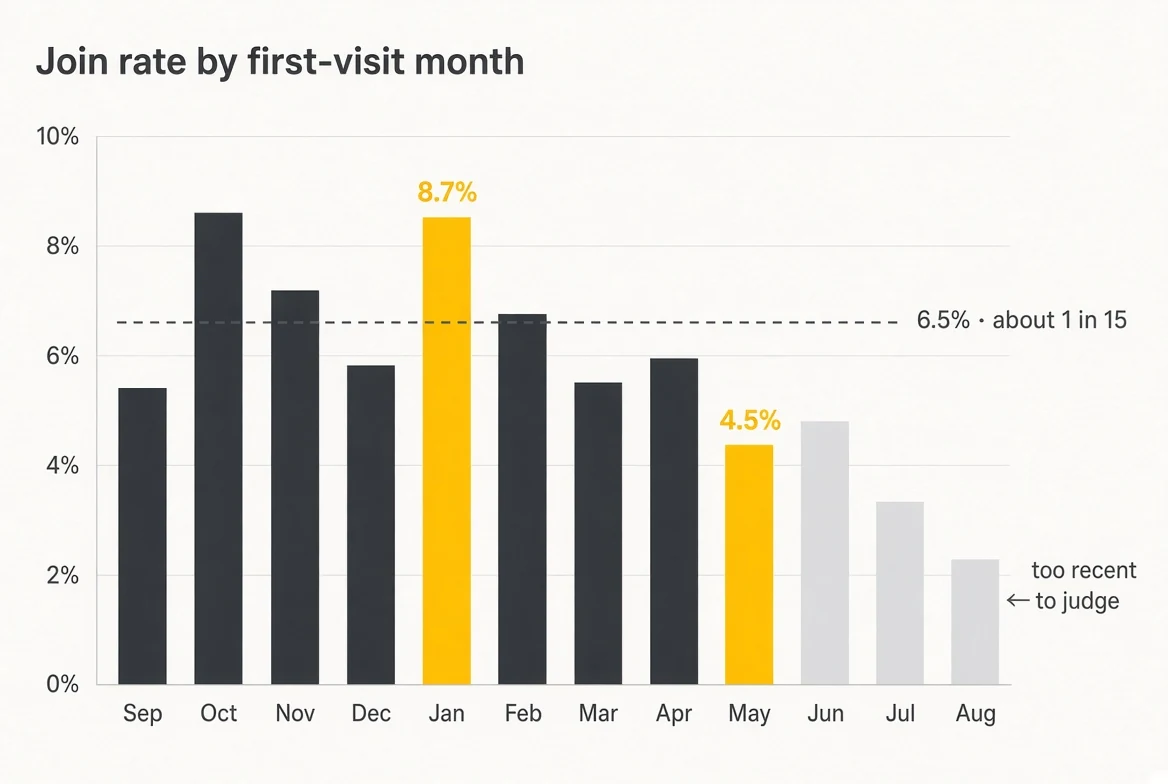
One climbing gym we work with took 14,634 brand new customers in twelve months. Not visits, not passes: people whose first ever purchase was a day pass. Of the ones who had been given enough time to decide, between 4% and 9% later bought a membership, depending on the month they first walked in. Call it 6.5%. A fitness gym, a CrossFit box or a yoga studio will see a different number, but the shape is the same: a visible join rate, a strong January, a desk that decides it.
The month matters. People who first visited in January joined at nearly 9%. People who first visited in May joined at under 5%. Same gym, same desk, same price. The January visitor arrived having already decided to change something, and the gym only had to not get in the way.
Most gyms cannot quote this number, and it is sitting in the booking system. Every first-time visitor has a first visit date. Every member has a start date. Join the two and you have the figure that says whether your problem is getting people in or keeping them.
Export two lists from your booking software: every customer with their first visit date, and every membership with its start date and the customer it belongs to. Match them, group by first-visit month, and the join rate falls out in a spreadsheet in an hour.
What is a first visit worth?
More than the pass, by a wide margin.
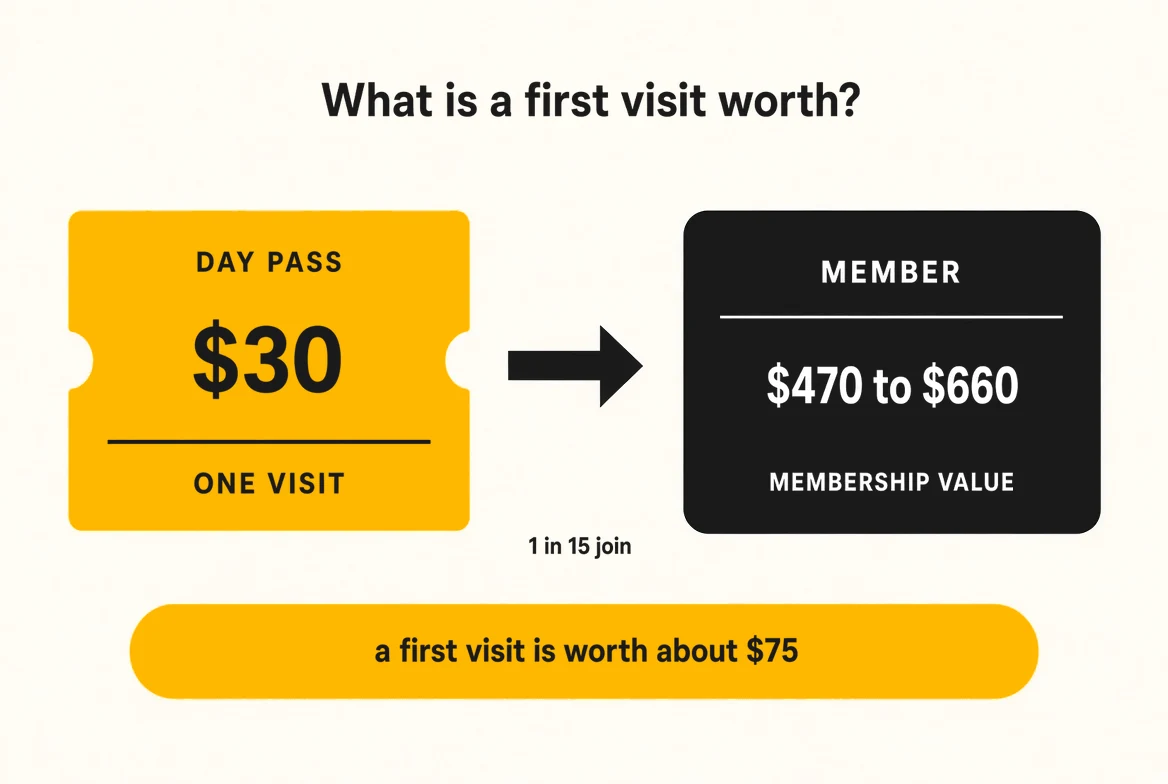
At the same gym a member pays about $94 a month and stays about seven months, so a member is worth $470 to $660. That is a floor: the long-tenure members still there are not in the average.
Multiply by the join rate and a first-time visitor is worth $40 to $50 in future membership revenue, on top of the $30 pass. A day pass is not a $30 sale. It is a one-in-fifteen chance at a $650 one.
Run your advertising against that number. In the gyms we run ads for, a booked free pass costs five to eight dollars. Against a $75 first-timer the sum works. Against a $30 pass it looks tight, and owners who judge ads on pass revenue cut them in the wrong month.
Why do most gym membership sales happen at the front desk?
Because that is where the customer is when they decide.
Over seven weeks this summer, the gym above sold 6,119 day passes. Three were bought online. Every other one was paid for at the counter, after the person had already walked in, looked around and decided to stay. The website brought them to the door. The desk made the sale.
That changes who your salesperson is. Not the ad, not the landing page, not the membership page with the comparison table. It is whoever is on the desk at seven on a Tuesday evening, and the question is whether anyone has told them what to say to a first-timer.
Two things belong at the desk. The first is the question “how did you hear about us?”, asked on the waiver so it gets answered every time. At that gym, between half and two thirds of first-timers in a given week say a friend or family member sent them, and about a quarter say Google. You cannot sell a second visit well if you do not know what sold the first one. The second is a reason to come back, offered before they leave, not emailed a week later.
What should happen after the first visit?
The second visit should be sold before the first one ends.
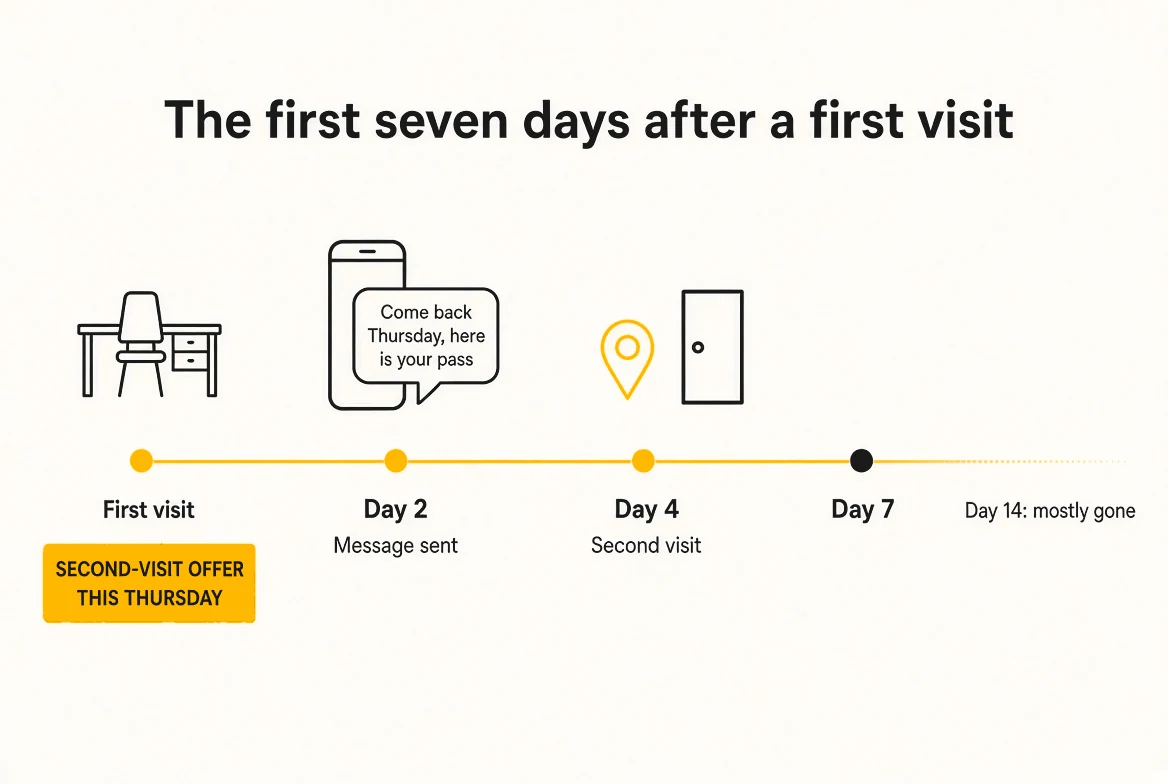
Most of the join rate is decided by whether there is a second visit at all. In our experience a first-timer who comes back inside a week has crossed the line from trying it to doing it, and one who has not come back inside two weeks is mostly gone. No email sequence brings them back from the sofa.
So the offer at the desk should be for the second visit, not the membership. A free week, an intro class on a named day, a second pass at half price if it is used within seven days. Something with a date on it. The membership conversation comes on visit two or three, when the person has already proved to themselves that they will come.
When that conversation comes, keep it short. Ask what they came in for and whether the visits so far have given it to them. Put the monthly price next to what they have already paid in passes, name the day they would come next, and stop. No tour of the tiers, no countdown offer. Someone who has been in three times in two weeks has decided. The desk’s job is to not talk them out of it, and to not leave them doing the sum alone.
It sounds like this. What brought you in? How has it gone? You have been in three times, which is about ninety dollars in passes. Membership is ninety-four a month. Shall I put you down for Thursdays? Three questions, one sum, one offer, under a minute.
Then follow up inside forty-eight hours, once, by text or email, with the same offer and the same date. Not a newsletter. Not a survey. One message that says come back Thursday, here is your pass.
The gap we see most often is the intro class. At the gym above, beginner day passes bring in about $100,000 a month. The intro class, the natural next step for every one of those people, brings in a few hundred. The product that converts a visitor into a climber was barely being offered to the largest group of beginners the gym has ever had. That is not a marketing problem. It is a desk problem, and it costs nothing to fix. Offer the class at the moment the day pass is bought, priced against the pass, with the next date on it, not on a poster by the door. Whatever the next step is in your gym, an intro package, a foundations class, a trial week, the same applies.
What gym membership marketing ideas actually work?
The ones aimed at people who have already been in.
A gym markets to three groups: people who have never visited, people who visited once, and members. Most gym membership marketing spends its money on the first and its hope on the third. The return is in the second. They know where you are, you have their email and phone number, and one in fifteen will join anyway. Your job is to make that one in ten.
Time the push. January first-timers joined at nearly twice the rate of May’s. Whatever you do for first-timers, do it hardest from the first week of January to the end of February, and have the desk ready before the holidays, not after.
Make the pass expire. A seven-day pass with a start date is a reason to come this week. An open-ended guest pass is a reason to come eventually, and eventually does not join.
Count it. Join rate by first-visit month, second-visit rate inside seven days, and intro class sign-ups per hundred first-timers. Three numbers, read monthly, and every campaign can be judged on members rather than clicks.
Where should a gym start with membership sales?
With the join rate.
Pull it this week: first-time visitors by month, and how many later bought a membership. Under 5%, the first visit and the follow-up are where the money is, and advertising harder mostly buys more people to lose. Over 8%, the gym sells itself and the job is to put more people through the door.
Then three things this week. Pull the join rate by first-visit month. Put one dated second-visit offer on the desk, with the intro class beside it. Follow up once inside two days.
If you want help reading the numbers and building the advertising on them, that is what our gym marketing and advertising service does.
Gym membership sales do not start at the membership desk. They start when someone walks in for the first time, and they are mostly decided by whether they walk in twice.
Figures in this post come from Portside client accounts and Portside’s own campaigns, anonymised. Ask us for the detail on a call.
Related Posts

Gym membership sales: how to sell memberships after the first visit